

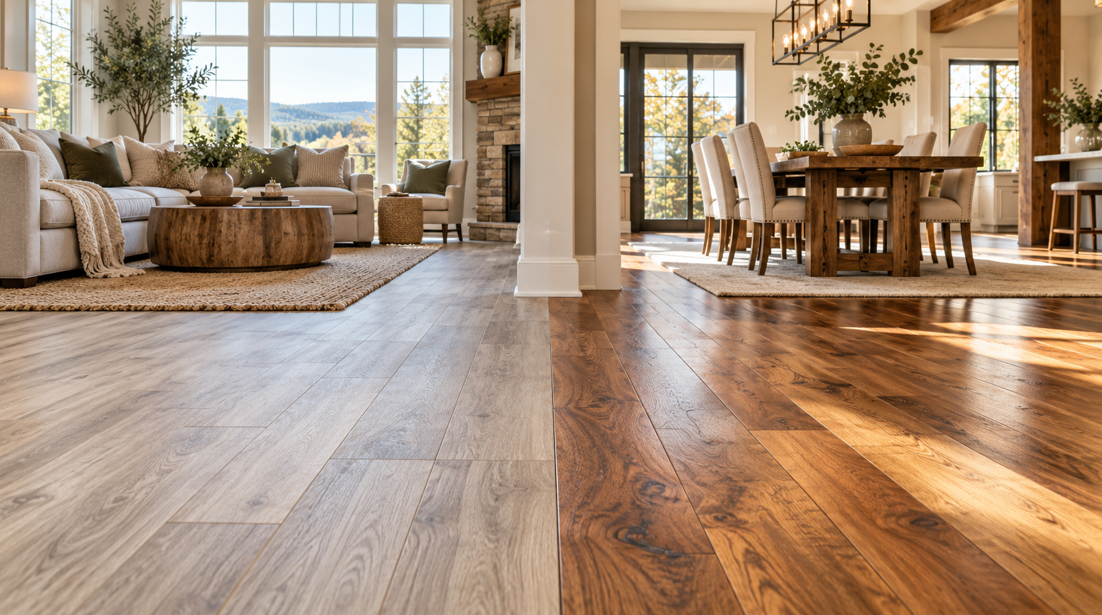
Choosing between laminate and hardwood can shape the look, feel, maintenance needs, and long-term value of a home. Both flooring types can create beautiful spaces, but they suit different priorities.
For Bethlehem homeowners, the decision often comes down to a few practical questions. How much traffic does the room receive? Are children or pets part of the household? Is natural wood character the priority, or would easier everyday care be more valuable? How will Pennsylvania's seasonal humidity changes affect the floor?
There isn't one flooring option that's better for every home.
Design Floors Lehigh Valley helps homeowners throughout Bethlehem and the surrounding Lehigh Valley compare flooring options based on lifestyle, design preferences, and the way each space is actually used.
This guide breaks down laminate and hardwood across appearance, durability, maintenance, moisture resistance, installation, comfort, cost considerations, and long-term value so homeowners can make a more confident choice.
What Is the Main Difference Between Laminate and Hardwood?
The biggest difference is the material itself.
Hardwood flooring is made from real wood. Depending on the product, it may be solid hardwood or engineered hardwood constructed with a genuine wood surface layer.
Laminate is a manufactured flooring product built in multiple layers. A decorative image layer creates the appearance of wood, while a durable wear layer protects the surface.
Modern laminate can reproduce the visual character of oak, maple, walnut, and other popular wood looks with impressive detail.
That means both floors can create a warm, stylish room, but they achieve that appearance differently.
Hardwood Offers Authentic Natural Variation
No 2 hardwood boards are exactly the same.
Natural grain patterns, knots, mineral streaks, and subtle color differences give hardwood its distinctive character. For homeowners who value authentic materials, those variations are often part of the appeal.
Hardwood can also change slightly over time as it is exposed to natural light and everyday living, giving the floor its own character.
Laminate Offers Consistent Design Flexibility
Laminate provides greater control over appearance because the design layer is manufactured.
Homeowners can choose from:
Light oak looks
Deep brown wood tones
Wide-plank designs
Rustic textures
Clean contemporary finishes
Traditional wood patterns
This makes laminate useful for homeowners who want a particular aesthetic without relying on the natural variation found in hardwood.
Which Flooring Looks Better?
Appearance is subjective.
Some homeowners immediately prefer the depth and natural variation of real hardwood. Others are impressed by how closely high-quality laminate can reproduce genuine wood.
The better question is: What kind of look is the home trying to achieve?
When Hardwood May Be the Better Visual Fit
Hardwood works particularly well when homeowners want:
Authentic wood grain
Natural variation from board to board
A premium material
A floor that can develop character over time
A strong connection to traditional or high-end interior design
It can complement both historic Bethlehem properties and newer homes with transitional or contemporary interiors.
When Laminate May Be the Better Visual Fit
Laminate can be a strong option when homeowners want:
Consistent color across a room
Specific wood-look designs
Current wide-plank styles
Flexible color choices
A polished appearance with less natural variation
Modern manufacturing has significantly improved texture and print quality, so laminate doesn't need to look artificial or generic.
The key is choosing a quality product with realistic grain patterns, texture, and plank variation.
Which Is More Durable for Everyday Life?
Durability depends partly on what type of wear the floor needs to handle.
Hardwood and laminate behave differently under daily use.
Laminate Handles Surface Wear Well
One of laminate's strongest advantages is its protective wear layer.
Quality laminate can perform well in households with:
Children
Pets
Frequent visitors
Active family spaces
Regular furniture movement
Busy hallways
Its surface is designed to resist everyday scuffs and wear.
That doesn't mean laminate is indestructible. Sharp impacts, standing water, dragging heavy furniture, and poor maintenance can still damage it.
However, homeowners who prioritize everyday practicality often appreciate its resilience.
Hardwood Can Last for Decades With Proper Care
Hardwood may develop scratches, dents, or visible wear more readily depending on the species and finish.
At the same time, hardwood has an important advantage: many wood floors can be refinished.
Rather than immediately replacing a worn floor, refinishing can restore its appearance by sanding away surface damage and applying a new finish.
That gives quality hardwood significant long-term potential.
A scratch on laminate generally cannot be sanded away because the decorative design sits beneath the wear layer.
So laminate may resist certain types of daily wear more effectively, while hardwood offers greater restoration potential over the long term.
How Do They Perform in Bethlehem's Changing Seasons?
Bethlehem experiences cold winters, warm summers, rainfall, and seasonal humidity changes.
Those conditions matter because flooring materials respond differently to moisture and indoor climate changes.
Hardwood Responds Naturally to Humidity
Real wood expands and contracts as environmental moisture levels change.
During humid periods, hardwood can absorb moisture and expand slightly. During dry winter months, it can release moisture and contract.
This movement is natural.
Stable indoor humidity, proper installation, and appropriate acclimation before installation all help support consistent performance.
Homeowners with hardwood may benefit from keeping indoor conditions within the range recommended by the flooring manufacturer.
Laminate Is More Dimensionally Stable, but Moisture Still Matters
Laminate doesn't react exactly like natural hardwood, but its core can still be affected by moisture.
Many modern products offer improved water resistance, and some are designed for areas where spills are more likely.
However, water resistance and waterproof performance are not automatically the same.
Homeowners comparing products can explore different laminate flooring styles and confirm the moisture-performance specifications of the individual product before selecting flooring for kitchens, entryways, or other active areas.
Which Flooring Is Easier to Maintain?
Both options can be relatively straightforward to maintain when cleaned properly.
The cleaning routine matters more than aggressive cleaning.
Caring for Laminate
Laminate generally works well with routine sweeping, dusting, or vacuuming using flooring-safe settings.
For deeper cleaning:
Use products approved for laminate.
Clean spills promptly.
Avoid excessive standing water.
Place mats at exterior entrances.
Use furniture pads beneath heavier pieces.
Keep abrasive debris from building up.
Because the surface is manufactured for durability, regular maintenance is usually manageable for busy households.
Caring for Hardwood
Hardwood also benefits from regular sweeping or vacuuming.
Good habits include:
Cleaning spills promptly
Using cleaners approved for the specific finish
Placing protective pads under furniture
Using rugs in heavily traveled areas
Limiting excess moisture
Keeping pet nails maintained
Hardwood finishes vary, so cleaning recommendations can differ from one floor to another.
The safest approach is to follow the manufacturer's guidance rather than relying on general household cleaners.
What About Homes With Children or Pets?
This is one of the most common practical considerations for flooring decisions.
Both options can work in family homes, but priorities matter.
Laminate for Active Households
Laminate can be appealing when scratch resistance and everyday practicality are high priorities.
Its protective wear layer may handle frequent foot traffic, toys, and pet activity well.
A lower-sheen or textured design can also help make minor marks less noticeable.
Hardwood for Families Who Value Long-Term Character
Hardwood can work beautifully in family homes, especially when a durable species and suitable finish are selected.
Minor surface marks may eventually become part of the floor's natural character.
If substantial wear develops years later, refinishing may provide a path to renewal.
Families who love the authenticity of natural wood may find that long-term flexibility especially valuable.
Which Is Better for High-Traffic Areas?
Hallways, living rooms, entryways, and open-plan spaces often receive constant activity.
For these areas, flooring needs to balance appearance with durability.
Laminate Can Be a Practical High-Traffic Choice
Laminate is often selected for busy rooms because its wear layer is built to withstand regular surface contact.
Consider laminate when the household prioritizes:
Scratch resistance
Consistent appearance
Easy routine maintenance
Reliable performance under regular foot traffic
Hardwood Offers Long-Term Restoration Potential
Hardwood may show wear sooner depending on the wood species and finish, but it can offer greater long-term renewal.
A floor that develops surface scratches over many years may be refinished instead of fully replaced.
For homeowners planning to remain in a property long term, that characteristic can carry significant value.
Which Flooring Works Better in Kitchens?
Kitchens introduce spills, dropped utensils, frequent foot traffic, and regular cleaning.
Both laminate and hardwood can work in kitchens when the specific flooring product is suitable for the space.
Laminate in Kitchens
Water-resistant laminate can be attractive for kitchens because it combines wood-look styling with practical performance.
Look carefully at the manufacturer's moisture rating rather than assuming every laminate product performs the same way.
Spills still benefit from prompt cleanup.
Hardwood in Kitchens
Hardwood creates visual continuity when the kitchen connects directly to a dining or living area.
A suitable protective finish can help manage regular household activity.
However, standing moisture deserves quick attention.
Rugs or mats near sinks and other splash-prone areas can provide additional surface protection.
What About Bedrooms and Living Rooms?
Bedrooms and living rooms generally give homeowners more flexibility because moisture exposure is lower.
Bedrooms
Both flooring types can work well.
Laminate provides a wide range of styles and can be paired with an area rug for added softness.
Hardwood creates a warm, natural atmosphere that may complement traditional and contemporary bedroom designs.
Living Rooms
Living rooms often become major design focal points.
Hardwood can add natural richness and visual depth, while laminate can deliver a similar wood-inspired aesthetic with greater consistency.
For open-plan homes, consider how the flooring connects visually with the kitchen, hallway, and dining areas.
Using one coordinated floor across connected spaces can make the interior feel larger and more unified.
How Does Installation Differ?
Installation can affect both project planning and overall flooring performance.
Hardwood Installation
Hardwood installation depends on the product type, subfloor, moisture conditions, and installation method.
Solid hardwood may be nailed or stapled in suitable applications, while engineered hardwood can offer additional installation flexibility.
Professional preparation matters because hardwood's natural response to environmental moisture needs to be considered before installation begins.
Laminate Installation
Many laminate products use floating click-lock systems.
The planks connect together rather than being permanently attached to the subfloor.
A smooth, properly prepared surface remains important. Underlayment may also be required depending on the product and subfloor.
Although laminate installation can be relatively efficient, proper preparation still plays a major role in the finished result.
Which Feels Better Underfoot?
Hardwood typically feels solid and substantial underfoot because it is made from real wood.
That natural feel is one reason many homeowners continue to choose it.
Laminate can feel different depending on:
Product thickness
Core quality
Underlayment
Subfloor condition
Installation quality
Higher-quality laminate paired with suitable underlayment can provide a comfortable, stable walking surface.
Some underlayments can also help reduce sound transmission and create a softer feel.
Homeowners sensitive to noise may want to compare flooring assemblies rather than evaluating the surface material alone.
Which Option Offers More Design Variety?
Both categories offer extensive design possibilities.
Hardwood Design Choices
Hardwood can vary by:
Wood species
Plank width
Grade
Stain color
Texture
Finish
Sheen
Natural variation means every installation has its own character.
Laminate Design Choices
Laminate offers impressive flexibility because its visual layer can reproduce many materials and wood species.
Designs may range from pale Scandinavian-inspired oak looks to deep walnut tones and rustic reclaimed-wood styles.
Homeowners can often find a laminate design for nearly any interior theme.
Which Flooring Offers Better Long-Term Value?
Value isn't determined solely by the initial flooring selection.
It also includes longevity, maintenance, appearance, and how well the floor suits the property.
Hardwood's Long-Term Appeal
Hardwood is widely associated with premium residential interiors.
Its natural material, refinishing potential, and timeless appearance can make it attractive to homeowners thinking about long-term ownership.
Properly maintained hardwood can remain part of a home for many years.
Laminate's Practical Value
Laminate provides access to stylish wood-inspired designs while offering strong everyday durability.
For homeowners prioritizing practical performance, consistent aesthetics, and manageable maintenance, it can deliver excellent value.
Rather than asking which option is inherently more valuable, consider which one provides more value for the household's priorities.
Which Flooring Is Better for Your Bethlehem Home?
The answer depends on how the room is used and what matters most to the household.
Laminate May Be a Better Fit If:
Scratch resistance is a major priority.
The home has children or pets.
Easy maintenance matters.
A consistent wood-look design is preferred.
The room experiences frequent foot traffic.
Modern design variety is important.
Hardwood May Be a Better Fit If:
Authentic natural wood is a priority.
Unique grain and board variation are desirable.
Long-term refinishing potential matters.
A premium natural material is preferred.
The homeowner values the way real wood develops character over time.
Either Can Work When:
The product is suitable for the intended room.
Installation is handled correctly.
Moisture exposure is considered.
Maintenance recommendations are followed.
The design complements the rest of the home.
There is no need to select a flooring material based on a single advantage.
The strongest decision considers the entire household.
Ask These Questions Before Making the Final Decision
Before choosing laminate or hardwood, consider:
Which rooms are being updated?
How much daily traffic does each space receive?
Are pets or young children regularly using the room?
Is authentic natural wood important?
How much maintenance feels realistic?
Does the household want the option to refinish the floor later?
Are spills or moisture likely in the room?
What colors and plank styles fit the interior?
How long is the flooring expected to remain in place?
What does the manufacturer recommend for the specific product?
Looking at larger flooring samples in the home can also help.
Natural daylight, evening lighting, wall colors, cabinetry, and furniture can all change how a floor appears compared with a small showroom sample.
Choose Flooring That Fits the Way You Live
Laminate and hardwood can both create beautiful interiors, but they offer different advantages.
Laminate stands out for durable surface performance, broad design flexibility, and practical everyday care. Hardwood offers authentic natural character, long-term refinishing potential, and a distinctive material that can evolve with the home.
For Bethlehem homeowners, local seasonal changes also deserve consideration. Product quality, professional installation, indoor humidity management, and regular care all influence how either floor performs over time.
The best flooring isn't simply the option with the longest list of features. It's the floor that matches the household's priorities, design preferences, and everyday routine.
Design Floors Lehigh Valley brings more than 30 years of flooring experience to homeowners throughout Bethlehem and the surrounding area, with a wide selection of products, free in-home estimates, and professional installation support.
For help comparing laminate and hardwood options for a Bethlehem home, reach out to us for personalized flooring guidance.


